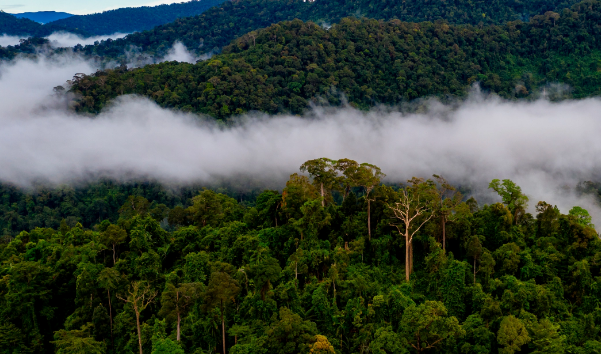
A flying river is a truly unique meteorological phenomenon, in which large quantities of water vapor are carried by winds in the atmosphere over long – or even very long – distances, often from the canopy of tropical forests to other regions of the continent where they form. Unlike terrestrial rivers, these rivers are made up of water in the form of vapor and their path depends on atmospheric currents.
The Amazon is one of the most emblematic examples where this unique natural phenomenon occurs. Forest trees absorb water from the ground, which they then release into the atmosphere in the form of vapor, through a process calledevapotranspiration. It is a gigantic blue breath, made up of billions of liters of water, which is released into the air every day.
The vapor is then transported by winds to other regions of South America, such as the Andes, southern Brazil, Colombia, Peru and even Ecuador.
Some scientists call it beautiful, dreamlike fairy dust.
This vapor is truly eminently magical; THE atmospheric rivers that generates they are vital for regional climate balances : they cause the precipitation necessary to irrigate agricultural land, fill hydroelectric reservoirs and regulate temperature.
The demanding culture of specialty coffees it is one of the agricultural crops directly dependent on these magical rivers.
The coffee-producing regions, located in the tropical belt (between the two tropics: Cancer and Capricorn), including those of Latin America – made up in particular of Colombia, Brazil, Peru and also Ecuador – take advantage of rainfall transported by these rivers generated by the Amazon forest. These regular rains, combined with moderate temperatures and a favorable altitude, create the ideal conditions for the production of arabica coffee quality, with fine, complex and balanced aromas.
Without the constant supply of this atmospheric humidity, coffee plants would be exposed to periods of drought and water stress, resulting in reduced yields and a decline in quality.
The deforestation of the Amazon – which was unfortunately intense under the reign of Jair Bolsonaro (president from 2019 to 2022) and against which the current Lula regime is trying to fight, not without difficulty – therefore threatens much more than biodiversity or the climate as a whole: it endangers fragile crops linked to the ecosystem and the good health of natural water cycles.
Small specialty coffee producers – who make up the vast majority of growers of this exceptional product – who rely on agroecology see their future compromised if radical changes don’t happen now.
Faced with these challenges, many players in the specialty coffee chain are committed to practicing common sense: reforestation around the farms, agroforestry, support for local communities. By promoting traceable coffees from farms committed to preserving their environment – and well beyond our common environment – roasters and we consumers – indirectly participate in the protection of these flying rivers.
After Paris, in 2022 in Avignon, a exposure gripping – titled Amazon – from the famous I photograph Franco-Brazilian Sebastiano Salgado passed away this year at the age of 81. We had the great fortune of visiting it. Through two hundred photographs, fantastically arranged, Salgado offered us a magical crossing of the Amazon.
Through his black and white, dazzling and silent photographs, this artist has managed to do so reveal the soul of a living forestinhabited, but threatened. Some have revealed these little-known, life-carrying flying rivers.
Through his work as a sincere humanist, Salgado reminded us that what seems distant concerns us all; that beauty is fragile; that living beings are vulnerable; that nature does not belong to us but is an immensity of which we are only a component equal to the others. And photographing also means denouncing, warning, arousing.
latest posts published

The Golden Café turmeric recipe

Definition: Hazelnut coffee – Cafés Méo
The definitive guide to coffee capsules: compatibility, flavors and problems for the planet

Is coffee high in calories?
What is the difference between instant and ground coffee?
How to make Italian coffee

Cold Brew: history and recipe for a refreshing revolution
What is robusta coffee?
How to clean the coffee machine