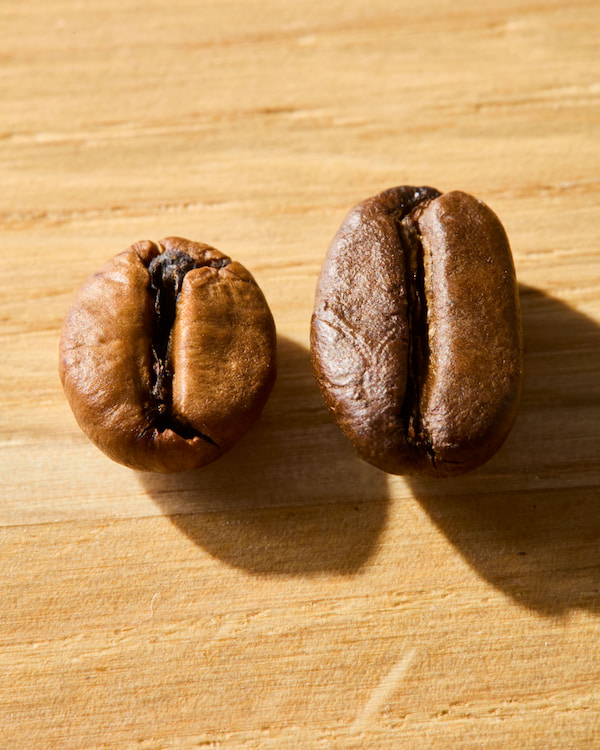

3,556,638: this is the number of tons of coffee that Brazil produced in 2018 (source: atlassocio.com). This is an important fact that justifies the title of “1st world producer of coffee«, this for 3 centuries! How did this country become a coffee giant? We will explain everything to you.
HISTORY
It’s just inside 1726 that coffee culture began in Brazil. Until then, the country was best known for its red rosewood, called “Pão do Brazil” by Native Americans, and which gave the country its name.
It all begins with a conquest… of love, in which lieutenant colonel Francisco de Melo Palheta who went on a mission to Guyana to steal a coffee plant and leaves with a bouquet of flowers to the wife of the country’s governor. Inside this bouquet are coffee seeds.
In 1820, Brazil managed to export almost 120 tons of coffeeallowing it to become one of the largest coffee producers in the world. From 1840, Brazil became Leading country in the production and export of coffee. It should be noted that in this period coffee was grown by slaves under the yoke of the «coffee barons»: rich men with lands. Very quickly, coffee plantations emerged. 300-400 slaves capable of counting 400,000 to 500,000 feet of coffeewith very low production costs, which cause the fall in world prices. The abolition of slavery was proclaimed in 1888, the last American country to abolish it.
The year 1920 was marked by the heyday of Brazilian coffee: more than 80% of the world’s population consumes it! Increasing competition, climate change and disease mean that today Brazil has lost its greatness and feels more fragile, sometimes endangering the coffee economy.
WHAT IS THE DISTRIBUTION OF COFFEE IN THE BRAZILIAN TERRITORY?
Brazil is known for its great diversity of coffee as there are reliefs and altitudes that allow it to be grown equally well. Arabica What the Robusta. Today, Brazil is believed to produce around 85% Arabica compared to 15% Robusta. There are 5 geographical areas where coffee is grown :
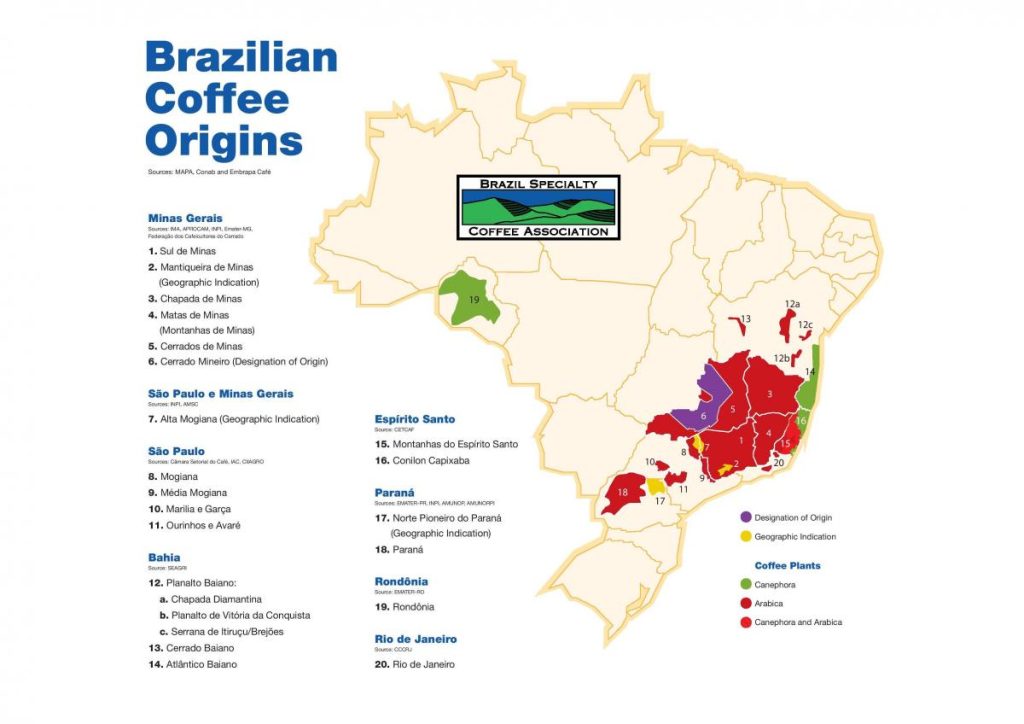
- Minas Gerais : Located in the east of the country, there are approximately one million hectares of coffee cultivation in this state. The state of Minas Gerais alone produces around 50% of Brazil’s total coffee due to low land prices, abundance of labor, mountainous topography and climate which are ideal conditions for coffee.
Aromatic profile: round, sweet and juicy, with light acidity and a rich bodyAnd
- Bay : Located in the northeast of the country, on the Atlantic coast, Bahia’s coffee culture has recently developed in this area.
Flavor Profile: Light texture with a gourmet flavor profile with flavours hazelnut chocolate.
Thanks to the low altitude of the region’s coffee plantations, the producers cultivate exclusively Robusta.
Aromatic profile: A gourmet character characterized by notes of chocolate and praline. The body is controlled and the profile balanced.
Cradle of coffee culture in Brazil, this is where the first coffee plants were planted. Cultivation takes place on the hills of the region.
Aromatic profile: Round body, nice acidity and fruity aromas.
Located in the south of the country, this particularly humid area allows it the cultivation of Arabica.
Aromatic profile: soft and fruity with a light acidity.

WHAT ARE THE PROCESSES USED BY BRAZILIANS?
There are 2 main methods in the coffee harvesting process:
- Stripping: the mechanical method
It consists of collecting everything found on the same branch through a sieve. Unfortunately this harvest is not selective regarding the quality of the coffee cherries. This is the most used method in Brazil.
- Picking: the manual method
It is possible to manually harvest coffee cherries from the branch, which allows for more selective harvesting. This process is certainly better from the point of view of product quality, but it takes a lot of time.
Once collected, the coffee cherries they are processed wet, semi-wet or dry depending on the places where this collection is carried out.
Known by all, Brazilian coffee is a reference in the world. At Méo, we invite you to discover the Paranà Reserve : a cvery balanced coffee and slowly roasted to release the best of its aromas.
latest posts published

The Golden Café turmeric recipe

Definition: Hazelnut coffee – Cafés Méo
The definitive guide to coffee capsules: compatibility, flavors and problems for the planet

Is coffee high in calories?
What is the difference between instant and ground coffee?
How to make Italian coffee

Cold Brew: history and recipe for a refreshing revolution
What is robusta coffee?

How to clean the coffee machine