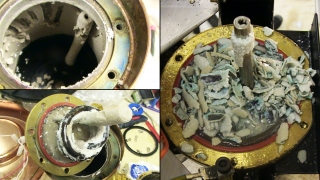
Whoever ends up reading this article probably already owns an espresso machine. I hope it hasn’t broken due to poor maintenance and I also hope that you have tried effective descaling methods, without making mistakes in the concentrations and without drinking coffee with cleaning solutions, in the first shots after the operation. Neglect leads to something like this:
Let’s learn how to descale correctly!
This article refers to the majority of domestic, semi-automatic, single-boiler espresso machines in the consumer range, excluding the more advanced devices of the HX (Heat Exchanger) or Dual Boiler type, which require a special maintenance procedure (piece-by-piece disassembly of some parts). I will not go into automatic machines, because they have a different mode of operation, although part of this article is also based on their specifics. I will always say it: money wasted on these machines, at home…
1. Prevention: take into account the water used, which will accelerate (or not) calcification! It doesn’t matter if you use flat, filtered or well water, look at the analyses, next to the chemical elements that favor calcification – Calcium and Magnesium – and next to the «dry residue at 180 degrees» parameter. Normally, hardness or TDS should be calculated with approved instruments. However, just read the labels or analyzes and aim for a maximum of 15 mg/l for Ca and 5 mg/l for Mg. There are many very hard still waters, with 50..70..90 mg/l of Ca. Protect your espresso machine from them! To be honest, unfortunately (because the competition would have helped) only Bucovina is suitable for espresso, according to the labels. I didn’t mention tap water, because in most locations it’s very hard and tastes like chlorine, so it’s not suitable for espresso except under certain filtration conditions!
2. When is descaling carried out? – Don’t wait for your device to freeze. Once every two months, maximum three, the operation must be repeated. Furthermore, if you notice white crystals on the bottom of the tank even before the two months, it means that the time has come! If you use low hardness water, the need for descaling may appear much later. Moreover, acids are used in this operation and it is best to repeat the procedure at intervals as rare as possible.
3. The descaling solution: on the profile sites you will find various dedicated products. But a question arises: if most descalers on the market contain citric acid as the active ingredient (i.e. lemon salt), why can’t we use lemon salt directly at home? Look for a normal shop in the market that sells lemon salt and you will have solved the problem of descaling solution in an economical and effective way. However, since common products are disappearing from the market, I have also seen 4 lei sachets in DM shops, these are ok too. There may be other options and I invite you to include them in the comments, to avoid spending a lot on something that is not necessary. Tartaric acid is also used, but from what I have read it is a bit dangerous for the body, so it should be avoided. Another alternative is vinegar, but its effectiveness is not comparable to that of citric acid, in addition to the terrifying smell it leaves in the house and car 🙂
But be careful! DO NOT exceed the optimal concentration of a maximum of two tablespoons per liter of water. Basically, put 1l of water at room temperature in a container, add two grated tablespoons of lemon salt and mix well, well, until all the crystals dissolve and pour this solution into the water tank. One report pointed out to me that someone with a vending machine put a few sachets of lemon salt in the machine, then it broke and they came to repair it, risking losing the warranty! Since the machines are more pretentious, use the instructions in the manual or on specialized forums.
4. Carrying out the operation:
- disconnect the device from the power supply
- before inserting the tank with the solution into the espresso machine, loosen the screw securing the «shower» and remove the perforated plate from there. Other espresso coffee machines do not have a single plate but multiple elements, which can be removed, washed and possibly placed for 20/30 minutes in another solution of hot water and degreasing detergent (costs around 30 lei/box).
- mount the water tank, connect the espresso machine to the electricity, turn it on and start the pump, letting 150-200 ml of water flow. Repeat the operation also for the steam circuit: press the steam button, turn the pressure wheel, start the pump and let 150-200 ml of water flow through the steam wand.
- (bracket) if you have an espresso machine with a solenoid valve (3-way valve), you will have to do an additional operation – install an empty sieve, without holes (sold separately) in the filter holder, put the solution from the tank into the filter and with the filter holder installed let the pump run for just 10 seconds. This way you will also clean the solenoid valve from limescale. The same should be done weekly, but with a special degreasing detergent, not with salt and lemon. Details in this clip.
- turn off the device for 15 minutes.
- repeat the previous steps until the tank runs out of water, with 15 minute breaks. in which the appliance is turned off, so as not to overheat too much. Loaded with citric acid and heated, it may damage internal parts.
- when you have consumed all the solution, rinse the tank and add fresh water. You will repeat the descaling steps, except stopping the espresso machine for 15 minutes, only you will only use water. For the solenoid valve devices we were talking about, a (second) internal rinse will also be carried out with the filter empty. If the last «shot of water» is acidic (coming from the lemon salt), you can fill the tank with a little water and perform additional rinses.
Make sure that between these operations, due to the emptying of the tank, the espresso coffee machine does not remain open and with the boiler empty. This is actually general advice. When the resistance runs out, without water, the thermostat is no longer able to control the temperature in the boiler, and it heats up to bursting!
If it’s serious and can’t be repaired, save at least a few hundred lei by taking advantage of it discounts directly to importers, on the dedicated page on Espressoman.
hard work
latest posts published

The Golden Café turmeric recipe

Definition: Hazelnut coffee – Cafés Méo
The definitive guide to coffee capsules: compatibility, flavors and problems for the planet

Is coffee high in calories?
What is the difference between instant and ground coffee?
How to make Italian coffee

Cold Brew: history and recipe for a refreshing revolution

What is robusta coffee?
How to clean the coffee machine