…or why espresso drinkers run away from one hole 🙂
Both on the forum and in emails and Google search reports, I’ve noticed a large percentage of users wondering what’s wrong with the sites in the portafilter? Why do we talk about pressurization and non-pressurization? Which are the best?
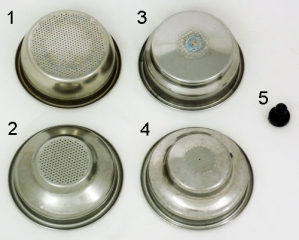
As an introductory note, pressurized sieves have a single hole in the bottom and resemble those in positions 3 and 4, while non-pressurized sieves have many holes in the bottom and resemble those in positions 1 and 2:
*Photo source: gallacoffeeblog.co.uk
If you are a beginner and don’t know what type you have, always look at the back of the sieve or in the light, because the pressurized ones have a sieve inside that gives you the impression that it has many holes. This is because there are two layers, one made of a perforated film and another made of a film with a single hole. I met users who «swore» to use non-pressurized screens, because they only looked inside 🙂 I also met users who cut out the second layer with the flex, in order to «depressurize» the screen, but for 25 lei it’s not worth it, plus you choose a Romanian improvisation and not a useful accessory.
Once we all understand what we’re talking about, we can move forward. We know that to obtain an espresso, a pump pushes the water into the boiler and from there it passes hot through a block of coffee, which is compacted in a sieve (filter). It would be normal for the water to encounter no obstacles until it reaches the cup, apart from the coffee block, so that the pressure to which the appliance has been adjusted (preferably 9 bar) can be found throughout the entire extraction period, and the delivery of the oils and aromas of the coffee occurs naturally, without any forcing. This way the resulting crema will drip into the cup, depending on the freshness of the coffee, and will not turn into a foam, with lots of air bubbles. This can only happen if you use a sieve with many holes in the bottom (not pressurized). Logically, what would have happened if I had used a pressurized one? The water no longer flowed naturally through the coffee and then through a perforated sieve, but «struggled» to come out only from a hole, creating further pressure on the coffee pod (hence the name «pressurized»), the taste being definitively affected and the crema destroyed. But where do you put the fact that most appliances are set very high in pressure (to be able to support the pods), therefore, above 13-15 bars which already slightly changed the taste of the espresso, there is also the obstruction of the liquid in a sieve under pressure…
There are also (many) cases, especially when we talk about cheap devices, in which the filter holder has been pressurized, i.e. the filter used is a normal non-pressurized filter, but the filter holder has a system that blocks the large drain holes, forcing the liquid coming from the filter to exit through a tiny internal hole. Fortunately, in most cases, this filter holder pressurization system is removable, fixing it with screws or using a simple rubber disk:
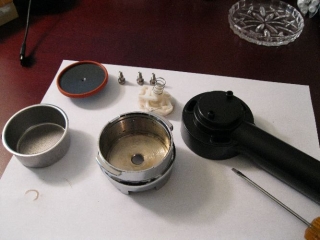
*photo source – Home Barista
Of course you will wonder why producers would resort to these tricks?! The answer is simple: over time they have received many complaints from uninformed customers, «who don’t make foam», despite having spent a lot of money on the machine (the perception of the value of the espresso machine is subjective, it depends on everyone’s income). It would be pure suicide if the salesman told the customer: «go buy a grinder», so it is easier to invent something that deceives the untrained eye. And just like that, pressurization appeared. The situation has become even more controversial since Gaggia replaced the old, normal, non-pressurized filters with others that were previously optionally pressurized, under the name «perfect cream filter». Unlike many other brands that produce rubbish, these actually had good espresso machines, and this move drew a lot of criticism on forums around the world. But here too there is half the glass, that is, any professional 58mm strainer fits the Gaggia, including the famous VST or Synesso, the replacement cost starts from 20-25 lei. In the case of other brands we need to talk about it in detail, because Ascaso has non-pressurized sites on the top Steel PID model but pressurized on the entry level ones, Lelit uses non-pressurized ones and optionally offers pressurized ones. It is useless to discuss the big brands that also produce semi-professional products, you can convince yourself of the Chinese ones of Altex/Domo…
In conclusion, pressurized sieves can be used when you have not yet purchased a coffee grinder and opt for already ground coffee from the store. It is very likely that the result will be nicer than if you used a non-pressurized sieve. But from the moment you really want to get a tailor-made espresso and you have purchased a coffee grinder, pressurization must necessarily disappear from the equation, and I am referring here to the plastic cup that comes with this type of filter. Of course, in theory you can get espresso with a strainer under pressure, grinding more coarsely and reducing the dose, so that the fine coffee doesn’t block that hole. But why should we make this sacrifice? Why not extract the maximum amount of aromatic oils from properly ground coffee? Why not lick your face with such a creamy espresso?
The technical solution is very simple and has nothing to do with the loss of the warranty. If you just need to change the filters, search on Google for various spare parts shops for espresso machines, because they also carry such filters. Make sure in advance you know the diameter of the sieve and the amount of coffee you want to put in it. For example, for a double espresso (60 ml) you will need a 14 g strainer, the 15 or 18 g ones from VST are also fine. For classic espresso (30 ml) you need a 7 g strainer. Speaking of VST, they seem to be the most popular sites in the world, due to the precision of the holes and the shape. They are also the most expensive, as you can see here. Whether it’s worth it or not is a little harder to say (I’m inclined to think so), but this article on coffeegeek might enlighten you.
We can discuss a lot on this topic, which is why I invite you to the Espressoman Forum, to open new topics of interest to you.
latest posts published

The Golden Café turmeric recipe

Definition: Hazelnut coffee – Cafés Méo
The definitive guide to coffee capsules: compatibility, flavors and problems for the planet

Is coffee high in calories?
What is the difference between instant and ground coffee?

How to make Italian coffee

Cold Brew: history and recipe for a refreshing revolution

What is robusta coffee?

How to clean the coffee machine