
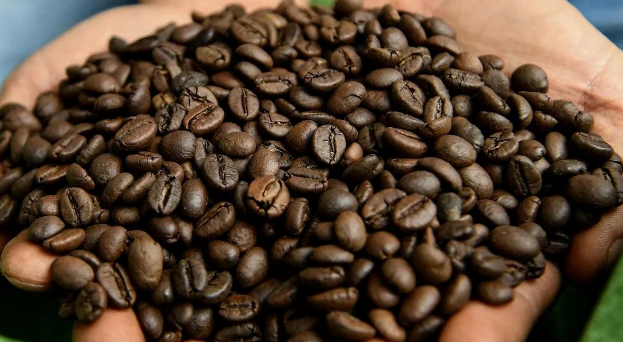
Coffee is one of the most popular drinks in the world. Millions of people start the day by enjoying this drink for its aroma and the energy it gives every morning.
You get espresso coffee roasted and ground coffee beans. Today there is a wide variety of preparation methods, the most popular of which are: kettle, espresso, moka, filter, v60, siphon, cold brew and aeropress. Each method has its own distinctive characteristics and the drinks prepared have different aromas and tastes.
Originally there were several types (varieties) of coffee, but the first two are the best known. In what follows we will talk about Arabica coffee, Robusta coffee, Liberica coffee, Maragogype, St. Helena, Kopi Luwak and Black Ivory.
Although in theory there is a wide variety of coffee varieties, in practice we very often find Arabica coffee and Robusta coffee on the market.
1. Arabica coffee
Arabica coffee represents approximately 60-70% of the total production of coffee beans in the world. Most of it is produced industrially in Brazil, which is the leading producing country.
Arabica coffee is appreciated for its aroma and less intense taste compared to robusta, which is a more bitter and intense coffee. It is obtained from the Arabica coffee tree and its origin is in Ethiopia, discovered by chance by a shepherd. In a previous article we discussed in detail the differences between Arabica and Robusta. You can read it here.
Arabica coffee has almost 200 different species. Among the most important we remember:
- Typica, the best-known species of Arabica, cultivated in Central America
- Bourbon – appreciated species that has a more intense aroma, with slightly bitter notes
- Caturra – variant of the Bourbon species which takes its name from the Brazilian city where it was planted for the first time. It stands out for its resistance to cultivation conditions.
- Columbiana – Arabica species produced in Colombia
- Java – arabica species grown on the Indonesian island of Java
- Catuai – is a variety of Arabica coffee known for its resistance to environmental conditions
- Mundo Novo – species often found in Brazil, where due to environmental conditions it produces rich fruits
2. Robusta coffee
Robusta coffee (Coffea canephora or Coffea robusta) is a more intense coffee, rich in caffeine, with a full body and less aroma. As a variety it is more resistant to environmental conditions than Arabica coffee. It is cultivated in Africa and Asia, in the lower regions.

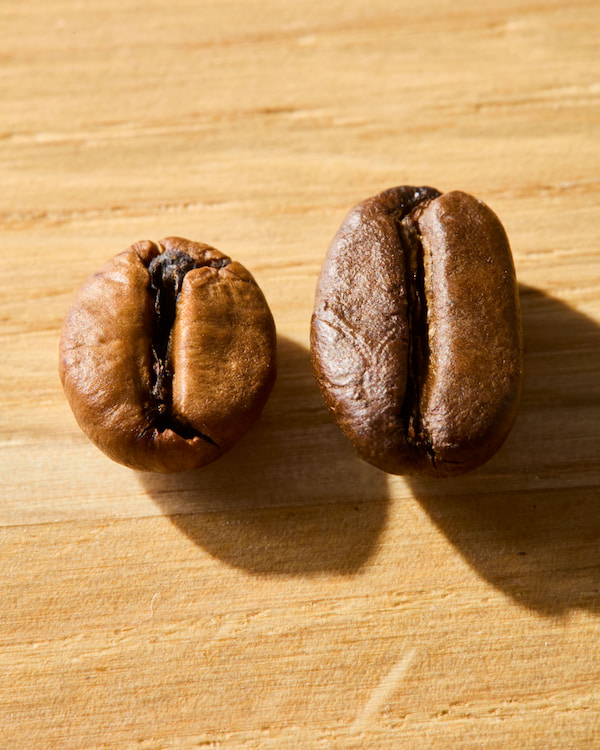
From a shape point of view, the bean is smaller than arabica and the groove is straight and S-shaped in arabica. It is used as it is or mixed with arabica coffee for the preparation of coffee with the espresso method. It is mainly used for espresso because of the rich crema it produces.
3. Liberian coffee
Liberica coffee is similar to Robusta coffee, first grown in the African country of Liberia, but has a fruitier flavor profile. Today it is found in Africa and South America, in regions with high humidity but lower temperatures (20-25 degrees).
The species is resistant to environmental conditions, but the coffee is considered mediocre. Although the beans are large, this coffee is not always appreciated for its quality, but rather for its unique physical characteristic.
4. Excelsa coffee

Excelsa (Coffea excelsa), sometimes considered a subspecies of Liberica, is appreciated for its aromatic complexity, with a fruity profile and unique acidity. It is grown in small quantities and used mostly in blends to add depth and variety.
Types of exotic and special coffees
In addition to the main botanical types, there are some specialty coffees that stand out for their unique production process or for their rarity:
Maragogype
Maragogype coffee is a superior coffee obtained by crossing the arabica and robusta species. Its name comes from a city in Brazil. It is believed that coffee has the largest beans, the size of which is 2-3 larger than the normal bean. Today it is grown in regions such as Guatemala, Nicaragua, Brazil, Mexico, Colombia and Java.
Saint Helena
It is also called Napoleon’s coffee, being his favorite during his exile in this country. It is a superior coffee, grown on volcanic soil, with intense floral, citrus and caramelized notes. Plantations are limited and this coffee is considered a luxury.
Mongoose coffee
It is a very special coffee, grown on the islands of Java, Sumatra, Bali and the Philippines. After harvesting, the berries are ingested and then eliminated by an animal called the palm civet. It is believed that the animal chooses the best beans and that the enzyme in its stomach plays the role of reducing the bitter taste of the coffee. There is controversy surrounding this coffee because the process can involve animal cruelty (civet cats are often kept in captivity). However, there are ethically certified variants that do not involve such practices.
Ivory Black
Black Ivory is the most expensive coffee in the world, with a similar history to that of Kopi Luwak coffee. The difference is that coffee beans are ingested and eliminated by elephants. This coffee is very rare and can only be enjoyed in a few 5 star hotels in the world. Black Ivory is mainly produced in Thailand and production is extremely limited (around 150 kg/year).
Coffee is subject to people’s subjective appreciation. Some choose an intense coffee, others, on the contrary, want a drink rich in flavor and less intense. There is a wide variety of species and preparation methods.
Whatever your preference, at Espresso Cafe you can choose your favorite coffee from a range with fast delivery by courier. Here are some of our recommendations:
latest posts published

The Golden Café turmeric recipe

Definition: Hazelnut coffee – Cafés Méo
The definitive guide to coffee capsules: compatibility, flavors and problems for the planet

Is coffee high in calories?
What is the difference between instant and ground coffee?
How to make Italian coffee

Cold Brew: history and recipe for a refreshing revolution
What is robusta coffee?

How to clean the coffee machine