Let’s take a closer look at what the right dosage for filter coffee.
To prepare an excellent filter coffee it is necessary carefully measure the right amount of ground coffee and hot water.
The ideal ratio recommended by professional bartenders East of 1 liter of water/60 grams of coffee.
So, if you want to prepare a large coffee for 1 person (cup type), we recommend you do so put 250g of water for 15g of coffee. All you have to do is apply the famous cross product rule.
Dosing the coffee correctly is therefore essential to obtain a good filter coffee and avoid stocking juice 😉. Your coffee will thus reveal all its aromas and flavors.
Also, it’s best to have a scale to weigh your coffee and water. However, if you don’t have one, keep this in mindu one teaspoon is generally equivalent to approximately 5 grams of ground coffee. But this obviously depends on the size of the ground coffee.
It is also essential to match the coffee grind size to your equipment to extract enough components from the coffee bean. This will prevent you from developing too much bitterness or too much acidity.
The grind size depends on the coffee machine used.
. Espresso coffee machine : extremely fine grinding (In this case a special grinder is needed. Today you can find good quality products on the market. There are also quality automatic machines with a directly integrated grain grinder.)
. Italian coffee maker = Mocha : fine grinding
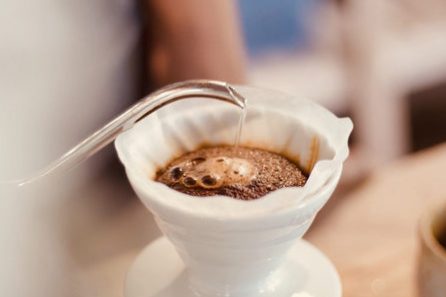
. V60 or conical filter holder classic or electric coffee maker : medium grinding (between fine salt and icing sugar)
. Chemex : coarse grinding (between icing sugar and coarse salt)
. French press = French coffee maker : coarse grinding (coarse salt)
. AeroPress : you can try anything, but we prefer a medium grind (between fine salt and icing sugar).
The use of a grinder is therefore essential to find the right grind. It is therefore preferable to purchase coffee beans.
What should I do if I don’t have a grinder? You can ask the roaster to grind your coffee according to your small equipment or your electric espresso machine.
THE specialty coffee roasters including those we refer to on our site, perfectly master the grinding size (= grain size). Just before being shipped to you, your coffee will be ground according to the rules of the art. The coffees are never placed in pre-ground bags. They will thus maintain optimal freshness.
Note: when it comes to quality coffee, and therefore special coffee, you will never have a fixed and predefined grind. For that?
Because there are other criteria that affect coffee extraction:
Such as:
. the coffee itself: its degree of roasting, its variety, etc.,
. the dose of coffee used: the higher the dose, the coarser the grinding of the beans must be. For that? To compensate for the flow time, which would otherwise be longer.
. extraction time. It will be more or less long depending on the device used.
For maceration devices (such as a pressure coffee maker) the extraction time must be longer than for a gravity method (Chemex, classic V-shaped conical filter holder (= dripper in English) or the Japanese V60 for example for connoisseurs).
The disadvantage of pre-ground coffee, sold commercially, is that it only has one grind size. It cannot therefore be suitable for all the different extraction methods, and even less for all those for the preparation of filter coffee. The defined basic grind is often too fine. You may have already noticed that when you prepare coffee with the French press with already ground coffee bags, a lot of the grind passes through the filter. It’s the same thing for tea. The leaves are so fine or crushed that they pass through the filters.
Another parameter must be taken into account: the quality of your coffee. Ils they are called specialty coffees.
Choosing a quality coffee will also have a significant impact on the aromas and flavors in the cup. We therefore recommend that you choose a high quality coffee adapted to gentle methods from organic or sustainable agriculture.
For the preparation of your coffee, the choice of water it is also essential. A cup of coffee is in fact composed on average of 90%. It is the element that will allow the extraction of your coffee. Its quality and temperature will influence the result in the cup.
We recommend that you do not use tap water due to its chlorine taste. Instead, opt for mineral water with few minerals (about 150 mg/l of dry residue) or filtered water.
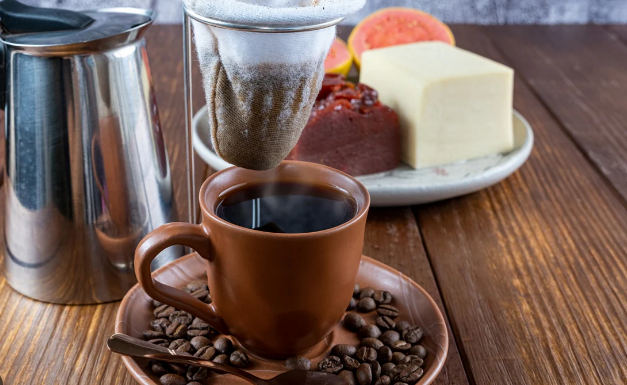
There are different types of filters: classic in paper or bamboo, in metal, in fabric (reusable and in nylon or organic cotton for example).
. Paper filters they have the great advantage of being made of dense fibers. They therefore do not let the grinding pass, which allows you to obtain a coffee without grounds at the bottom of the cup.
In general, you should always rinse the filter, otherwise it will leave a little papery taste.
Natural paper filters have a stronger paper flavor. They therefore require more rinsing with water than white paper ones.
The goal: to prevent the taste of the coffee from being altered.
. Fabric filters they are more eco-responsible because they are reusable. If they are organic it’s even better. But they need to be cleaned and dried before reuse.
. Metal filters they have the disadvantage of letting the grinding pass.
latest posts published
The Golden Café turmeric recipe
Definition: Hazelnut coffee – Cafés Méo
The definitive guide to coffee capsules: compatibility, flavors and problems for the planet

Is coffee high in calories?
What is the difference between instant and ground coffee?
How to make Italian coffee
Cold Brew: history and recipe for a refreshing revolution
What is robusta coffee?
How to clean the coffee machine