Article written by Andrei Stetcu (forum user: ondrej), for the espressoman.ro community
The coffee grinder or «the central piece for a perfect espresso» as you might read in another article, also exists in a manual version, not just an electric one.
It happens in the fall of 2011 when I purchased a manual grinder marked «Lehnartz» from the weekly flea market with the aim of grinding pepper when I need larger quantities. I reconditioned it and since I also had a passion for espresso, I said I would try putting in some coffee beans and see what comes out. I must say that two months earlier I had also purchased an MM Steel electric coffee grinder from Gaggia and, to my great surprise, the manual coffee grinder provided me with a grind that was uniform to the eye and touch, without fine dust like that produced by MM Steel and, above all, the coffee was not thermally affected given the very low speed (120-150 rpm). I’m no professional, but the difference in taste was noticeable, and I really wanted to make sure of the quality of the grinder by comparing my results with those of a professional bar grinder. Trying to make a difference between the two cars, I couldn’t really do it.
The «virus» had already been contacted and since then several dozen grinders from the main companies that I have overhauled have passed through my hands. Knowing their strengths and weaknesses, I thought I’d introduce them to you and give you some instructions to follow to get a manual grinder.
The main companies that produced grinders were: Pe De Dienes, Zassenhaus, Armin Trosser, Kym, Lehnartz, Leinbrock’s Jdeal, these were German made and occupied, from what I saw, about 80% of the market for old manual grinders. There are various models and the main ones are presented on this site. The only company that still maintains the bar high and that has resisted and still produces today is Zassenhaus, but with some innovations compared to what it produced a few decades ago, sparking intense debates from true connoisseurs on foreign specialized sites. Of course there are also other companies such as Peugeot, Kyocera, Hario and a few others, which we will talk about another time.
Among the advantages of a classic manual coffee grinder (available only in SH, given the age), I could list the price, which can be very low (5-10 euros), the size and reduced noise, the uniform grinding and not thermally influenced by the rotation, the minimal mess produced by the grinding, no accumulation of coffee that goes rancid, they do not require particular maintenance, having an extremely robust construction, you can take them with you if you are away from home for longer periods of time, plus they can also represent a decorative piece.
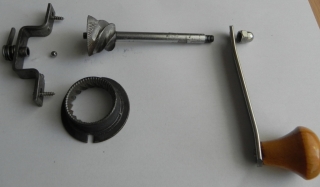
To have the best results it is necessary to take into account various aspects regarding the choice of grinding. The external appearance may mean that the grinder has been used a little and looked after, but that is not the point. In my case, the grinder that looked new on the outside when I bought it didn’t have much of a mechanism, and the cheaper one, for which I paid 20 lei, has the most precise mechanism. The grinders I purchased are all solid wood and the stainless steel or chrome alloy covers look excellent even 50 years after manufacturing. The ruined exterior, with a little skill, can be almost completely renovated. So the mechanism is obviously the most important thing. It is made of high hardness forged steel and is composed of the crank, the shaft with the rotor, the fixed knives and the stabilization mechanism:
The handle has more of an aesthetic role, but it must be taken into account that its greater length creates a lever arm that is too long, which can slightly destabilize the mechanism. Thus, the grinder shaft has a crank mounted on the upper part, which is fixed by screwing, and on the lower part the knives (rotor) are welded, forming a common body with it. It is very important to check that the axis has minimal play in the cylinder fixed to the cover, resulting in rotation with minimal deviations around its axis:
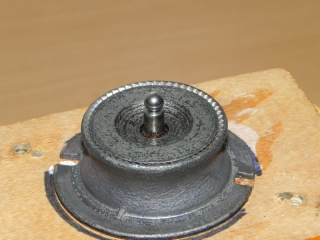
The fixed knives are positioned inside the grinder and on some models, the best, the stabilization mechanism and the granulation regulation mechanism are fixed under them, an operation which occurs by screwing:
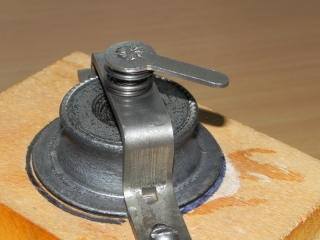
Stabilization is achieved through a screw of the mechanism that enters the hole on the lower part of the rotor and which can be screwed/unscrewed, thus regulating the granulation as the rotor approaches or moves away from the fixed knives. The best mechanisms (introduced at the time by the Lehnartz company) have a load-bearing ball placed on the screw and which then enters the rotor, thus counterbalancing the lateral movements and making grinding much easier:
This mechanism represents a huge advantage of the old grinders that is no longer found in the new Zassenhaus grinders, which stabilize the rotor only via some plastic teeth that detach from the jacket surrounding the fixed knives and which wear out quite quickly. This fact requires a change, as I saw on one site, and which I also did:
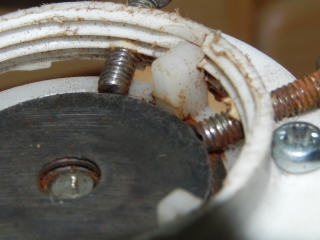
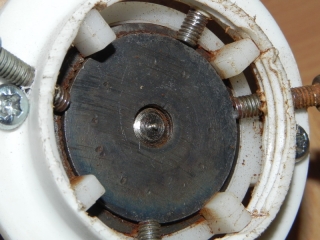
The regulation of the granulation, as I said before, is carried out with the aid of the screw placed on the stabilization mechanism or with the aid of the one placed under the crank which raises or lowers the rotor compared to the fixed knives, since these mechanisms have continuous regulation, there are also mechanisms with step regulation:
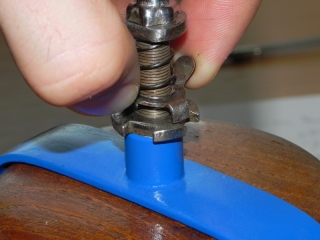
The disadvantage of the stepped adjustment is that, by setting the mechanism at a level that grinds the coffee too fine for an espresso, at the next higher step the grind will be a little coarse, while the correct adjustment is somewhere in between, a similar case with electric grinders.
As an observation from the tests, I found that the mechanism of the Lehnartz is slightly modified, i.e. the rotor has a smaller diameter and enters a little inside the fixed knives, this increases the quality of the machine:

I have personally only bought grinders from us in the country and after reconditioning a third are capable of grinding for espresso, but I have to admit that most of the ones on ebay.de look great and I have no doubt that the percentage of quality grinders is much higher. If the knives are worn you can sharpen them with precision files or take them to a fine butcher’s shop.
In terms of effort, to grind 15 g of coffee with the new Zassenhaus Brasilia coffee grinder I have, it takes about 110 turns of the crank (1 min.), just like with older coffee grinders. The main disadvantage of these grinders is that guests will have to be patient, because it takes a while to grind for everyone, that is if you no longer have manual grinders and are sharing the load 🙂
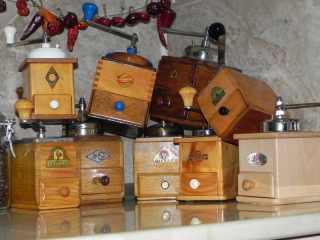
But when it comes to a double espresso, one minute is the most reasonable time possible, the effort is minimal and it depends a lot on the type of coffee.
Article written by Andrei Stetcu (forum user: ondrej), for the espressoman.ro community. I invite you to comment on this article on the Espressoman.ro Forum, in the manual grinding section, by clicking here!
latest posts published
The Golden Café turmeric recipe
Definition: Hazelnut coffee – Cafés Méo
The definitive guide to coffee capsules: compatibility, flavors and problems for the planet

Is coffee high in calories?
What is the difference between instant and ground coffee?
How to make Italian coffee

Cold Brew: history and recipe for a refreshing revolution

What is robusta coffee?
How to clean the coffee machine