Last week Metro Expo 2012 took place in Romexpo and I said that I would see the new Lelit and Cunill appliances live if the importer was still there. The first and biggest regret is that I didn’t have more time to test them, because I found them very interesting and each one really deserves a separate review, which I will do as soon as possible. On the first day I had Radu from Papajacques with me, and on the second day my fellow forum member Mokele 🙂 I will always repeat, I wish we were a more united and larger community, meeting more often to test various interesting tools!
But above all I would put the experience I had at the Jura stand, which is located right next to Lelit-Cunill. Why do I say this? Because I wanted to one day discuss with someone who represents vending machine brands and why not, see them in action. There I met a girl who was very knowledgeable in marketing (hi Delia 🙂 ), but very little informed about what an espresso really means and what the parameters are for obtaining it. Of course I can’t blame her at all, because she did her job and supported her brand which guarantees her work. And he did it well! In fact, most of the people who passed by these stalls stopped at Jura, not at Gaggia-Lelit-Cunill, the automatic machines with lights and colored displays being much more attractive to the population.
Where does the joy of arriving at the Jura stand come from? From the fact that it has been demonstrated to me countless times, that for those who want to have an espresso comparable to those drunk in good bars or a creamy (not foamy) cappuccino, the machines, of any brand, are money thrown out the window!
The first time I asked for an espresso from the Jura Ena 7 or the IMPRESSA XS90 One Touch, I don’t remember well, the tool costs 2800 lei + VAT. First I was introduced to the «big advantages» of the device, crowned by the 5-step grinding (!!!). Of course I figured the 5 steps couldn’t do much and the espresso flowed in 10 seconds. Clear, under-extracted and free of humidity, even though the grind was set to maximum fineness.
I explained to the interlocutor that the machines cannot do exactly this, the calibration of the grinder with the extraction system, so that, in 25 seconds, 30 ml of 7-8 g of coffee come out. Only then does a complete extraction take place, revealing the aromas of the respective coffee. (yes) That’s why the advertisement for the «perfect espresso» Jura + Tchibo, which is now on TV, is a deep lie, because machines can’t do it and Tchibo is a coffee for the masses, especially bad! At least the «new» Sicily and Milan varieties are truly awful!
Disappointed with the result and asking for more from these machines, which are rather expensive, the answer was: «let’s move on to the new Jura IMPRESSA J9 One Touch» (I hope I’m not wrong about the model) which has 6 coffee grinder steps (!!!) and can prepare 19 milk and coffee specialities. For those who don’t know and don’t want to learn to appreciate a real espresso or a creamy cappuccino, obviously the large and colorful display with many buttons, plus the multitude of drinks it can prepare, is an advantage and a point of reference for purchase, and a lady who is in a hurry or has a smaller office, or simply someone not primarily interested in the quality of the drink, will be impressed and maybe even buy the device. And don’t think I have a problem with this, because they nailed it! But the other category of customers, who are looking for a delicious espresso first and then a creamy cappuccino, should think not twice but ten times before purchasing, especially since it is also a good amount of money! At my request, the Jura representative performed the most refined step, set the temperature from low to high (another improper and useless marketing gimmick, instead of PID), selected the pre-infusion (almost irrelevant function, taking into account the operating mode) and the 8000 lei espresso machine was ready for a perfect espresso followed by a delicious cappuccino. The flow is strange due to the pre-infusion we were talking about (which is common with taximo), i.e. it drips a little coffee for two or three seconds, after a pause of a few seconds it starts flowing again… very strange! This happens, probably, because the machine wants to moisten the coffee pod, but throws too much water and at too high pressure, some of which falls into the cup in the form of «espresso». Next, I expected deeper extraction from a 2000E espresso machine. But the miracle lasted only 8-9 seconds, 30 ml of espresso flows faster than with the 3300 lei machine.

So I debunked another myth, the size (of price) doesn’t matter 🙂 However, if we talk about the size of the «vessel» in which the water is heated, then things start to matter. Starting from 700 lei, quality semi-automatic espresso machines have the boiler, as the price also increases in size, so a 700E espresso machine has a 1.5 l boiler, all for enviable thermal stability. So I had big reason to be puzzled when the Jura representative started praising the thermal block of these devices, which actually means an aluminum box, with some coils inside, that looks like this. The idea is that as the water is used for espresso, say, another fresh water will come in from the tank, which will be at room temperature. If the heating vessel is not suitable (a boiler, preferably as large as possible), the temperature will obviously drop as the hot water mixes with the cold water. An aluminum box, the thermal block, will never have the power of a water heater to maintain a constant water temperature and make the entry of cold water «imperceptible». Think about taking a shower with water from a boiler or an aluminum box with coils inside. In which situation do you think you will have hot water for longer, at a constant temperature?
The second chapter tested was milk foam. At the push of a button, the espresso machine would draw milk from the external tank and instantly fill the glass, then brew a «ristretto» and the drink was ready (probably a latte machiato or some kind of cappuccino). Anyone who tried such a drink two steps away, in the bar where, among others, the champion bartenders Flori and Paul served free lattes, immediately noticed the difference between the milk cream and the foam produced by the machine. Tasting what Jura prepared, I noticed what could be seen with the naked eye: a very inconsistent drink, with many small air bubbles inside, something similar to the foam of beer, which you drink but it doesn’t feel like you are swallowing a real liquid. Exactly what you try to avoid when you prepare a cappuccino and whisk the table cup, then stir the contents, this is in fact the difference between milk cream and milk foam.
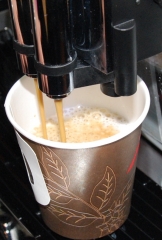
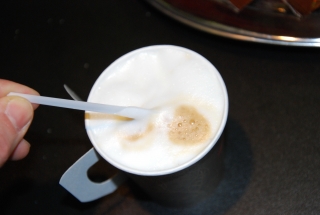
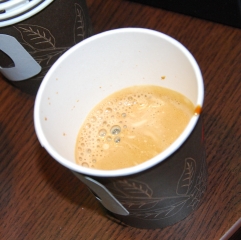
Likewise, in the case of espresso made with automatic machines, instead of being a consistent, dense and creamy liquid, due to the incomplete extraction that the automatic machine does, the liquid will be far from these characteristics, with air bubbles on top and without that full taste that fills the mouth with sensations, characteristics of a correct extraction, in a semi-automatic machine.
Let’s be honest, I have nothing to do with this Jura brand, I put it together with Gaggia, Phillips Saeco, etc. automatic machines. (although each brand believes they are the best), differentiating them from the «Chinese» Krups and DeLonghi, in terms of reliability and tradition in coffee. But when it comes to the quality of the resulting drink, compared to using a semi-automatic grinder and a separate coffee grinder, all automatics are the same. I would also add the fact that these considerations are made from the point of view of an espresso & latte enthusiast, who tries to drink some quality drinks every day. If we are talking about an office where everyone prefers a certain drink and it has to be available at any time, or a person who wants to drink something ultra-fast in the morning or people (especially women) who want to spoil themselves by playing with the beautiful colorful display, then an automatic is all they would want, and I encourage their purchase instead of capsule machines, the lowest point in terms of espresso & milk!
I hope to have the opportunity to do a back to back test, between an expensive automatic coffee grinder and a semi-automatic + espresso set of maximum 400E. At this fair, my request (sent via the importer Gaggia-Lelit-Cunill) was rejected by Razvan, the manager of Jura, on the grounds that «the displayed vending machines are not calibrated». It would be interesting to film the results and publish them on the blog, so that everyone can express their opinion as objectively as possible.
latest posts published
The Golden Café turmeric recipe
Definition: Hazelnut coffee – Cafés Méo
The definitive guide to coffee capsules: compatibility, flavors and problems for the planet

Is coffee high in calories?
What is the difference between instant and ground coffee?
How to make Italian coffee
Cold Brew: history and recipe for a refreshing revolution
What is robusta coffee?
How to clean the coffee machine