
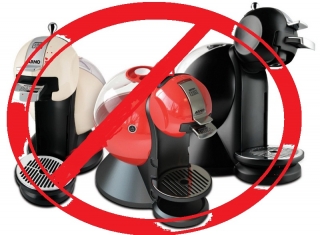
I admit that it was very difficult for me to choose the title of this post. I oscillated between several obscene titles:
The success of Nescafè Dolce Gusto or the triumph of chemistry over nature
Nescafè Dolce Gusto – When you drink marketing instead of espresso
Nescafè Dolce Gusto – or how some make money from Romanian «café» culture.
For those unfamiliar with the art of espresso, I have to draw a line from the beginning, between reality and imitation: This sensational drink is obtained in optimal parameters by grinding 7 or 14 g of coffee (espresso/double espresso) immediately before preparation and extraction with an espresso machine Semi-automatic30/60ml of liqueur, passing the water through to approx. 88 degrees Celsius, with a pressure of 9barithrough the coffee block compacted with a press. Slight deviations from these figures are permitted.
The second premise to take into consideration is the fact that, in total, 90% of the population of our country lacks a minimum coffee culture (due to communism but also due to a lack of interest in what they drink), which leaves marketing offices with enormous margin for manoeuvre. With the help of beautiful images it is very easy to win over the Romanian consumer, because he does not know exactly the phenomenon and is immediately struck by a beautiful and memorable advertisement.
Nescafè has bet on a toy that is beautiful to look at, easy to use, with increasingly fun shapes and colours, all wrapped up in an aggressive marketing strategy. This results in high promotion costs which further translates into huge costs for purchasing the device and capsules. But the problem is not necessarily the money, but the result obtained. Instead of drinking espresso, you will swallow a dubious soup that you don’t even know what’s in it. Why do I say this? Let’s make a brief parallel: is what you eat at McDonald’s different in terms of ingredients from what you find in a package at McDrive? Not! So what reasons do we have for not believing that Nescafè doesn’t use the same ingredients in their city coffee and their takeaway coffee? Did you know that the coffee specialties served for 1 leu or in Nescafè bars contain: carboxymethyl cellulose, ammonia caramel, «flavoring», thickeners, «traces of soya», «powder preparation based on…», silicon dioxide, dipotassium phosphate, pentasodium triphosphate, trisodium citrate, polyphosphate, mono and diacetyl esters of mono and diglycerides with fatty acids… etc. Has anyone put their hand in the fire because Nescafè Dolce Gusto capsules contain nothing from the chemistry lesson above? Someone probably put it in there, but it could burn!
If you want, let’s also discuss the price – AT THE DATE OF WRITING OF THE ARTICLE (August 2011), a primitive box produced by a Chinese master of coin-operated machines (Krups), which costs no more than 40E, was sold for over 500 lei. The capsules, 16 of which only 8 contained coffee, cost 22 lei. So for 56g of coffee (8 x 7g) you paid 22 lei, that is around 400 lei/kg!!!! Here’s how much the most famous coffee in the world, Jamaica Blue Mountain, costs. If two people drank coffee a day, the capsules would last 4 days. If you make several coffees or have guests, you’re doing everything wrong! After a while, when many people realized the mistake and went back to the kettle, without buying the capsules, Nescafè reduced the price to 23 lei/16 espresso capsules (I’m not talking about the specialties with fake Italian names, which require two capsules, therefore 3 lei for one preparation), and the price of a lower kg of coffee from the capsule (even if it’s Arabica it’s penal as well as quality) comes to around 220 lei. To be more precise, instead of paying 60-90 lei for a super quality freshly roasted coffee or 40-50 lei for a bitter arabica from the supermarket at the level of the capsule one, you will pay 220 lei/kg and you will depend on a monopoly! This is the price of non-quality, haste, hasty decisions, lack of information and perhaps snobbery. Other promotions and special offers require other calculations, which you can do yourself, which is why I have eliminated this comparative mathematical calculation.
The solution? Open your eyes and read the espresso forums, both in Romania and abroad. Learn to make an espresso the traditional way (two minutes maximum every morning) and you will come out much cheaper, drink a much healthier drink, not depend on a capsule manufacturer and you will be able to choose from hundreds of types of coffee in this world!
Many will say that they don’t have time to make an Italian espresso in the morning and, even if they know a lot about what Dolce Gusto-type capsules mean, they compromise to get out of the house faster. OK! Let’s see how much time it would take you to prepare an espresso/cappuccino/espresso machiato in the best and traditional way:
httpv://www.youtube.com/watch?v=hoq08YBASTc
Without any rush (indeed I would say «in slow motion»), as you can see, the protagonist of the clip took less than two minutes for an espresso and another minute to froth the milk. Does it seem like a lot to you? Have you seen the chaos around? Would you need the knowledge of a professional bartender to do something like that? Is the delicious, consistent liquid that flows from the espresso machine comparable to soup capsules, regardless of brand? Haven’t you got the impression that it’s much more difficult to make an Italian espresso at home? Isn’t it better to choose the coffee beans you prefer rather than be the prisoner of a monopoly?
I want to believe that after 20 years since the revolution, there are many Romanians with an open mind, who are able to understand and adopt the values, quality and good taste and separate them from the manipulation and «guerrilla» marketing practiced by some or others. Nescafè Dolce Gusto is just an example of how to mislead those who don’t know. Although it presents itself as a colorful and fast alternative to the classic espresso preparation method, in reality it is nothing more than a cheap (paradoxically and expensive) imitation of this drink and its milk derivatives.
I wish you to be responsible and careful in your choices,
UPDATE 1: Following the various comments, I would like to clarify the following: I have nothing to do with anyone who buys capsule machines or automatic espresso machines. Each type of espresso machine has its own niche and is popular with people in that market niche. If you feel comfortable with him, there is absolutely no problem and there shouldn’t be! Everyone decides for himself! The problem arises when the happy owners/sellers of such fakes come and claim the superiority of the results obtained, comparable to the real espresso or the real cappuccino. Here I am transitory»
UPDATE 2: The article was focused on Dolce Gusto because at the time of writing there were no other competing brands in this segment in Romania. But it can easily be extended to Tassimo, Nespresso, Senseo, etc., with the update 1 specification.
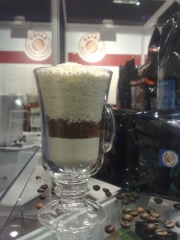
UPDATE 3: Following the example of the cigarette packs with the funeral photos, I propose a latte macchiato in the vision of these powder sellers, whoever they are, the pose taken at the Vending Expo, the coffee & milk chemists’ fair:
latest posts published
How did Slow Coffee Festival 2023 go?

What is espressoman.ro and what does it want?
“Brand” coffee (Illy and more) versus freshly roasted coffee
How did it go at the 2016 National Aeropress Championship
2016 at the end – perhaps the most prolific year of good coffee in Romania
Visit MetroExpo, with a stop in the Jura –
Cold Cappuccino | History, advice and recipes for home
Gaggia Espresso Pure modified or how to remove butter from the espresso machine
Bakers Association? First we drink a craft beer