*Article written by user Fane, moderator of the Espressoman Forum
Before the holidays I decided to give myself a gift and decided to change my espresso machine, especially since the machine I had (Gaggia Pure) was aging both physically and morally. Being a temporary decision, I didn’t have time to do much research and I took it more impulsively. For a long time I liked the look of lever machines (manual espresso machines) and talking with my friend Liviu about which machine to get, I discovered that they are not as expensive as I had the impression and that there is an importer of them in our country too. I did a quick Google search and saw that they are generally quite popular, so I contacted the importer, received the discount from the forum and the same day the espresso machine was already on its way to me. It was an impulsive decision, but it turned out to be a good decision.
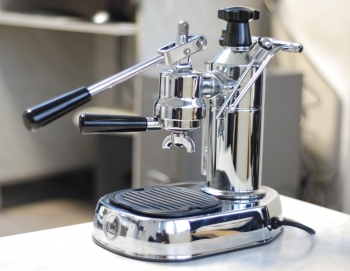
When the package arrived at home, I opened it with enthusiasm. The first impression confirmed my expectations: the device looks very good and is carefully made. We are talking about a manual espresso machine designed in the 1950s (I report the description on the La Pavoni page) and it is a really good indicator of how things were done at that time. The design is retro and functional, not like I’ve seen in some modern devices just a stylized retro look. It really feels like it’s made to last a lifetime because I don’t see much that would break it.
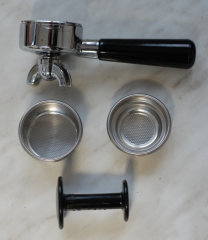
In the package, in addition to the well-packaged device, I found the filter holder, a single filter, a double filter and a plastic tamper, a bit like a toy, but sufficient to use the device (I will write why below):
Immediately after opening the package I tried to make an espresso and that’s where the fun began. I did the first extraction with a grinder calibrated for Gaggia Pure and with a quantity of coffee placed in the eye and the espresso came out a little «chopped». I weighed the coffee and it seemed like I put in too much because the puck was touching the top sieve of the group. So I started reading online what to do and I discovered that with this type of espresso coffee machine (manual), the pressing is not done in a decisive way, as with pump machines, only a light pressing is preferred (this is why I said above that the plastic tamper present in the package is enough). In practice, from what I have observed, tamping occurs when the filter holder is mounted on the group, which is why you need to be careful to close it in more or less the same position every time. Another thing I discovered from international forums is the fact that the «orthodoxy» of espresso with the famous 25 seconds is not valid. The extraction must be evaluated based on other factors – appearance of the cream, taste, etc. – for this reason the Pavoni Europiccola is not really an espresso machine recommended for beginners, because they do not have the necessary experience to adequately appreciate an espresso. So I continued to weigh the coffee, did a few more extractions to calibrate the grinder and the results began to appear in the cup. The espresso now has a much more pronounced body than I got with the old machine, using the same coffee, and some floral accents that I never achieved. It was the moment I realized that my impulsive choice wasn’t wrong. However, I advise you to inform yourself thoroughly before making any purchase.
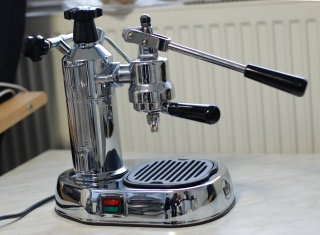
A particular aspect of this type of espresso coffee machine, compared to classic ones with a pump, is the force with which the lever is pressed during extraction, because the pressure is applied manually, precisely through this pressure. Those who are used to semi-automatic espresso machines, where perhaps they have lowered the pressure from 15 to 9 bars and noticed significantly better results in the cup, might think that the pressure with which they press the lever is fundamental. Well, that’s not exactly the case. To quote the appliance manual «the pressure must be dosed based on the resistance offered by the lever». This pressure cannot really be quantified, as can be done during tamping, when you put the portafilter on the scale and see what the pressing force is. You have to «put your hands» on the device, but I can estimate a compression of between 5 and 10 kg of force. Under no circumstances should it be «broken in two» with a very fine grind which is then compensated with strong pressure exerted on the lever. If in espresso coffee machines equipped with a pump too fine grinding leads to slowing down the flow or even blocking it, in the case of manual espresso machines you may tend to apply a large force on the lever to compensate. The coffee thus obtained will be over-extracted, with a burnt flavour, lacking aromas and bitterness, as well as subjecting the machine to inconveniences. Initially I thought that the more expensive manual espresso machines are equipped with a pressure gauge to help you measure the force to be applied on the lever and implicitly the pressure during extraction. After looking at the instruction manuals, I discovered that the pressure gauge does not measure the pressure during extraction, but the pressure of the steam coming from the boiler, so I decided to get the cheapest model, Europiccola without pressure gauge, and I think I made a good choice.
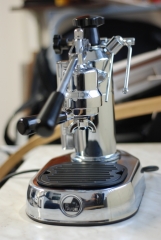
The espresso coffee machine is equipped with a boiler for 8 coffees, according to the manufacturer’s specifications, and also differs from classic machines in that it cannot be refilled «on the fly». In other words, if you want to put water in it, you must first let it cool down a little, because, during normal operation, the water in the boiler exceeds 100 degrees, and if you open the lid, hot steam will come out. But for a normal home user, the capacity it has is sufficient. We drink a lot of coffee and the kettle filled in the morning usually lasts us all day. The more expensive La Pavoni espresso machines also have a boiler for 16 coffees, which I believe is more than enough for the biggest coffee drinker, in a home use. These larger appliances probably heat up more easily, because mine heats up in the morning in 15-20 minutes (I leave it on during the day). For faster heating of the group, immediately after starting, the lever can be raised to the maximum, several times, with the filter holder mounted. In practice, once the boiler has reached operating temperature, the hot water will flow through the group and through the filter holder, these will heat up much more quickly, and the appliance will become “ready to fire” in a shorter time.
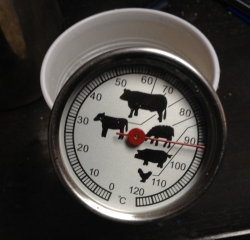
I couldn’t help myself and took a look inside the espresso machine, which I don’t recommend, especially since you really have nothing to look inside. The construction is simple, which I think is good, simplicity usually means reliability. The appliance is not equipped with a thermostat but with a pressure switch to control the boiler pressure and implicitly the water temperature. Although this heats up to over 100 degrees (be careful during operation, do not put your hand on the boiler because it burns!) the coffee comes out excellent, without a burnt taste, probably because the water cools when it passes through the group, becoming optimal for extraction. I measured the temperature of the water with a food thermometer after pouring it into a plastic glass and you can see the result in the photo:
I don’t think a change with PID is possible because it would interfere with the operation of the pressure switch. A PID could be installed just by deactivating the pressure switch, but I’m not sure what implications that would have and how safe it would be that the espresso machine would still be running, because excessively increasing the temperature of the water in the boiler will implicitly increase the pressure…
As for the milk rubbing, I can’t give you too many details because I’m arguing with the milkmaid 🙂 in our house we prefer coffee without milk. When I have time and desire to play I will also try the steam function, but not being a latte macchiato specialist, I don’t think I will be able to be objective in my evaluations. Reviews on international forums say that it would also be good from this point of view, especially since there are solid premises: the head of the steam pipe has three holes, the boiler is large, so it should guarantee pressure and volume of steam. The device comes with an attachment for easy cleaning, but I haven’t tried that yet either. If I were to start making milk cream for cappuccino, I will follow the classic method, being wary of these wonderful accessories. Perhaps another buyer of this device, with more experience than me on the milk-based drinks side, will help me complete the review.
To remember! My wife turned it on without water in the boiler and I got scared because the appliance stopped working. But after reading the manual, I discovered that La Pavoni Europiccola has overheating protection. If anyone else has this problem, look at the bottom of the espresso machine, where there is a rubber stopper, just under the center of the boiler. After removing it, you will see a small orange button that you press with something sharp and the device resets.
I also tried to film a shot, not exactly the most successful with this camera. It’s like this when you want to be a «teacher» 🙂
CONCLUSIONS
Pros:
– excellent extraction quality
– elegant design for those who are passionate about the retro look
– the device works well «out of the box», with the accessories included, without the need for setup.
– solid construction
Against:
– this type of device is not recommended for beginners (except for well-documented ones)
– the sieve has a diameter of 52 mm, so accessories such as a bottomless filter holder can only be purchased from the manufacturer (if available). For example, the VST screen is not produced with this diameter.
– The espresso machine must be left to cool before being filled with water.
Espressoman Note: For other discussions we look forward to seeing you on the forum, in the topic dedicated to this La Pavoni Europiccola Lusso manual espresso coffee machine. In the meantime (September 2015) we have obtained, exclusively for readers of the Espressoman platform, from the importer La Pavoni in Romania, a 15% discount for lever enthusiasts, through the discount table.
latest posts published
The Golden Café turmeric recipe
Definition: Hazelnut coffee – Cafés Méo
The definitive guide to coffee capsules: compatibility, flavors and problems for the planet

Is coffee high in calories?
What is the difference between instant and ground coffee?
How to make Italian coffee

Cold Brew: history and recipe for a refreshing revolution

What is robusta coffee?
How to clean the coffee machine