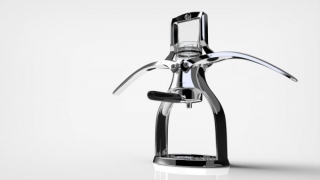
We have become accustomed on the forum to unraveling the thread when it comes to espresso and to almost obsessively investigating every phase of the preparation. And I am proud of what this community has done so far, unquestioningly increasing the level of accurate and real information on the ground, on the Romanian Internet. But what do you do when you go on holiday or visit your in-laws or book a relaxing weekend in the mountains and you can’t separate yourself from the taste of your espresso every day? The morning pleasures and more of your favorite cup will become just cravings, because there is nothing comfortable about throwing an espresso machine and coffee grinder in your luggage, risking them being ruined during transport. The designers probably had this scenario in mind when they created the cute little metal bird 🙂 aka the ROK Espresso portable espresso machine.
CONSTRUCTION:
Reading the home-barista/coffeegeek forums relatively often, I had heard about this unit for some time (initially with the name Presso, then improved and renamed ROK Espresso) but until it arrives in town so you can touch it, it is more difficult to comment on its usefulness and quality. It was the same with grinders, it took forever (20 years after the Revolution) for us to be able to find a good home coffee grinder for espresso quite easily in Romania, the shops intoxicated us with machines. I haven’t decided to gather all my favorite espresso machines and analyze them yet, but the ROK caught my attention in particular because of portability. I felt on my tongue what it means to drink something very different from home espresso, personally I can’t stand the kettle. Of course, there are many other alternative methods of preparing coffee, equally portable, and I think they will need to be analyzed better in the future. However, being a staunch espresso man, I only look for the ones that are closest to an espresso because the FrenchPress or the Chemex didn’t give me the same sensations at all. It’s probably a matter of taste.
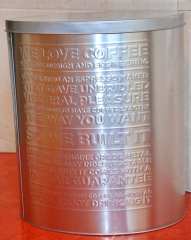
Returning to the topic of this mini review, ROK Espresso chooses to reveal itself to the owner in a rather extravagant way of presentation, presenting itself in a metal box similar to the special editions of whiskey 🙂 engraved with the designer’s message, designed to self-suggest you before opening it. Inside you will find the metal bird caught very firmly in the sponges (probably so as not to break the water container), a filter holder METALdivider for two cups, a mini instruction manual, an accessory for whipping milk foam and a more solid spoon, with a rounded bottom and about the same size as the filter holder, so that it can act as a tamper:
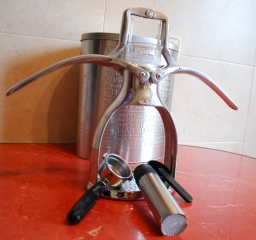
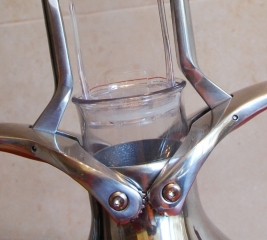
The first impression after taking it out of the box is extraordinary. You feel like a champion holding a trophy in the shape of an espresso machine, weighing around three kg 🙂 It’s very well built and, apart from the polycarbonate water container, nothing seems likely to break too soon. That’s why they write in the manual and on the website «10 year warranty», thinking about its duration, not the actual retailer warranty. The solid «motor metal» construction as ROK markets that (polished) aluminum alloy, is necessary because considerable (but not excessive) force is applied when making espresso, being, after all, a manual espresso machine. I don’t know what they put into the composition, but I was convinced I was holding a piece of steel in my hand.
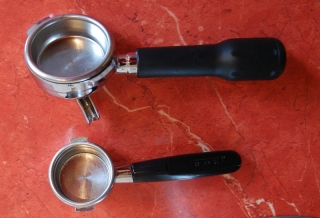
I liked the fact that they didn’t skimp on the filter holder, like many manufacturers do who put a layer of plastic even on the 300E devices, which is a shame. As you can see below, the filter holder is comparable in construction to that of my Bezzera, the dimensions are obviously different. They couldn’t even make it too thick because it would have been very difficult to heat it during extraction, we all know the importance of a hot portafilter in the process of making an espresso. A pleasant surprise is the non-pressurized sieve (50mm diameter), which allows you to grind the coffee to the grain you want, without forcing you to use a coarser grind. A pressurized sieve would probably have made pressing the wings much more difficult. Smart guys, what else… 🙂
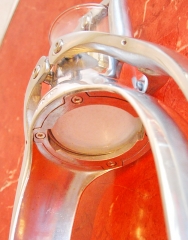
Still in the construction section I want to show you the piece through which the water passes from the tank to the filter holder, which did not strike me at all as the solution chosen, being made of a kind of silicone, with many holes over the entire surface. In practice, we wanted a «portable imitation» of the group of a normal espresso machine, that metal strainer that we call «dus», which in the vision of those at ROK looks like this:
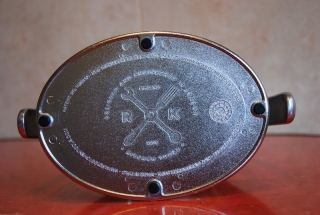
The base of this manual espresso machine is also sculpted in a very interesting way, in the latest update (with the name change to ROK Espresso from Presso) it received rubber feet, indispensable I would say, because during pressing the iron part was quite fixed. I think in the old version, Presso, there were a lot of cases of slipping, without those feet.
USE AND PERFORMANCE:
Once you have made espresso in your life, it will be very easy for you to understand how this machine works by applying the general theories related to the efforts for water temperature stability. Of course, these are too demanding terms for a portable manual, but even as a beginner you should know that it is best for the water temperature to be as constant as possible, from the boiler to contact with the water, during the seconds of delivery. But in the case of the ROK, having no electric resistance or boiler, just like a normal espresso machine, you will need a source of hot water, relatively easy to find at the place of accommodation when you go on holiday, and I would say, move quickly so that the water does not get cold. Still keeping thermal stability in mind, I would suggest holding the portafilter, for at least a minute, in a cup of hot water, then removing and drying it immediately before use. It’s not mandatory but it would help a lot.
The first experiment was a bit careless, letting the water sit too long in an uncovered container before pouring it. By cooling the water a little, the resulting espresso (using freshly roasted coffee ground before use for the granulation I was using on the Bezzera) had a more pronounced (acrylic) acidity side, a sign that the water used was a little cold. I repeated the experiment, this time pouring hot water over the portafilter, as I usually do at home, and moving a little faster. The strategy paid off and the taste has changed a lot for the better. Proof that details matter a lot in espresso.
The preparation routine is very simple to apply:
– put 12-14g of finely ground coffee, specific for espresso, into the filter holder previously heated with hot water (I repeat, it is not mandatory but it improves the taste a lot) (14g would mean a full filter holder). Here, a manual coffee grinder works wonders, along with freshly roasted coffee beans
– press the coffee into the filter holder with the bottom of the plastic measuring cup provided or if you have the means, build/buy a 50mm metal tamper
– open the flaps of the appliance so that the piston that pushes the water rises, fit the filter holder and pour in the hot water taken immediately from the heating source (stove, kettle, microwave), until the container is filled. Since there is no stop valve for the water, it will flow through the container directly into the portafilter, above the coffee. The great thing is that on this occasion a sort of pre-infusion is created, any cracks in the coffee pod, welding them together and making the block more compact.
– grasp the arms of the espresso machine with both hands and press with equal force until the end. I noted in their presentation clip that you can repeat the pressing operation once you get to the end, lifting the wings again. However, I would try to dose everything from the beginning and obtain 60 ml from the first, for a double espresso, because the water has already lost its temperature and we risk ruining the espresso, with overly acidic nuances.
– before removing the filter holder, you can place a basin under it, to eliminate excess water, by pressing it again or unscrewing it.
I also shot some video stills, so you can see «live» what ROK Espresso can do:
https://www.youtube.com/watch?v=UChQkYeRQa8
I don’t know if these preparation steps are difficult for a beginner to follow (I tend to think not), but those who already use an electric espresso machine will find it a breeze. Unlike the classic system, this manual involves you more during the extraction, actively participating in every step of the preparation. And for an enthusiast this is a unique sensation. Comparisons with manual espresso machines such as La Pavoni Europiccola will be inevitable, and I must underline that there is a clear difference between them, although I admit, initially I was tempted not to be so categorical. It’s true and in the case of the Pavoni the price is triple, but Europiccola is an autonomous espresso machine that can be used every day. I consider the ROK to be a great portable option, for those times when you want to take some of the flavor of the espresso you drink at home with you on vacation every morning (my fellow forum member Cosmin was right).
Curious by nature, I also tried using the accessory to whip milk foam. If on the espresso side, with a little practice you can get a fairly good shot, on the cappuccino side the foam obtained from cold milk is a far cry from the milk cream made with the home espresso machine. But taking into account that we stayed in a tent and heated water on a wood fire, what more demands do we have? Or that we stay in a guesthouse that provides us with a bitter coffee filter? Or that at your parents’ house you only find the classic kettle? The great thing is that you can prepare a pseudo-cappuccino or a pseudo-latte machiato by «pumping» the milk for about 30 seconds (similar to the French Press method) until it has a thicker and frothier consistency:
https://www.youtube.com/watch?v=8dLpH_amXk4
AGAINST:
When it comes to price, ROK Espresso doesn’t make too many concessions. They probably thought about positioning themselves higher, not for those who have never had an espresso machine, but for those with average and above-average incomes, who want a portable, vacation/travel alternative to the home espresso machine. In Romania it arrives in stores for 730 lei, but as usual Espressoman.ro readers have a 10% discount at the importer (via the discount table), so we will be able to get it with 650 lei. It is not a small price, but it has the advantage that you will not change the consumables (mesh, textile or metal filters), which accumulate over time…
CONCLUSION:
If you’re an espresso enthusiast, I can put my finger on the story because a few freshly roasted beans and a manual coffee grinder will make the ROK indispensable on any trip, successfully alleviating the nostalgia of your espresso at home. I can also guess that in the above setup, you will hardly find a hotel, restaurant or guesthouse in tourist Romania, capable of offering you a better shot, than joke in the local horeca, except for some more serious cafes. The manual espresso machine naturally brings with it both advantages and disadvantages, as we have analyzed above, but for those who absolutely want espresso on holiday, the sensation of preparing a ROK and the results obtained will delight every morning away from home.
To discuss the topic together, we look forward to seeing you on the forum, where ROK Espresso has a dedicated topic.
latest posts published
The Golden Café turmeric recipe
Definition: Hazelnut coffee – Cafés Méo
The definitive guide to coffee capsules: compatibility, flavors and problems for the planet

Is coffee high in calories?
What is the difference between instant and ground coffee?
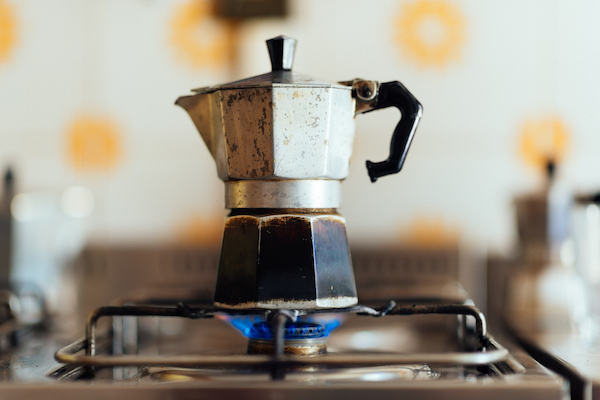
How to make Italian coffee

Cold Brew: history and recipe for a refreshing revolution

What is robusta coffee?
How to clean the coffee machine